

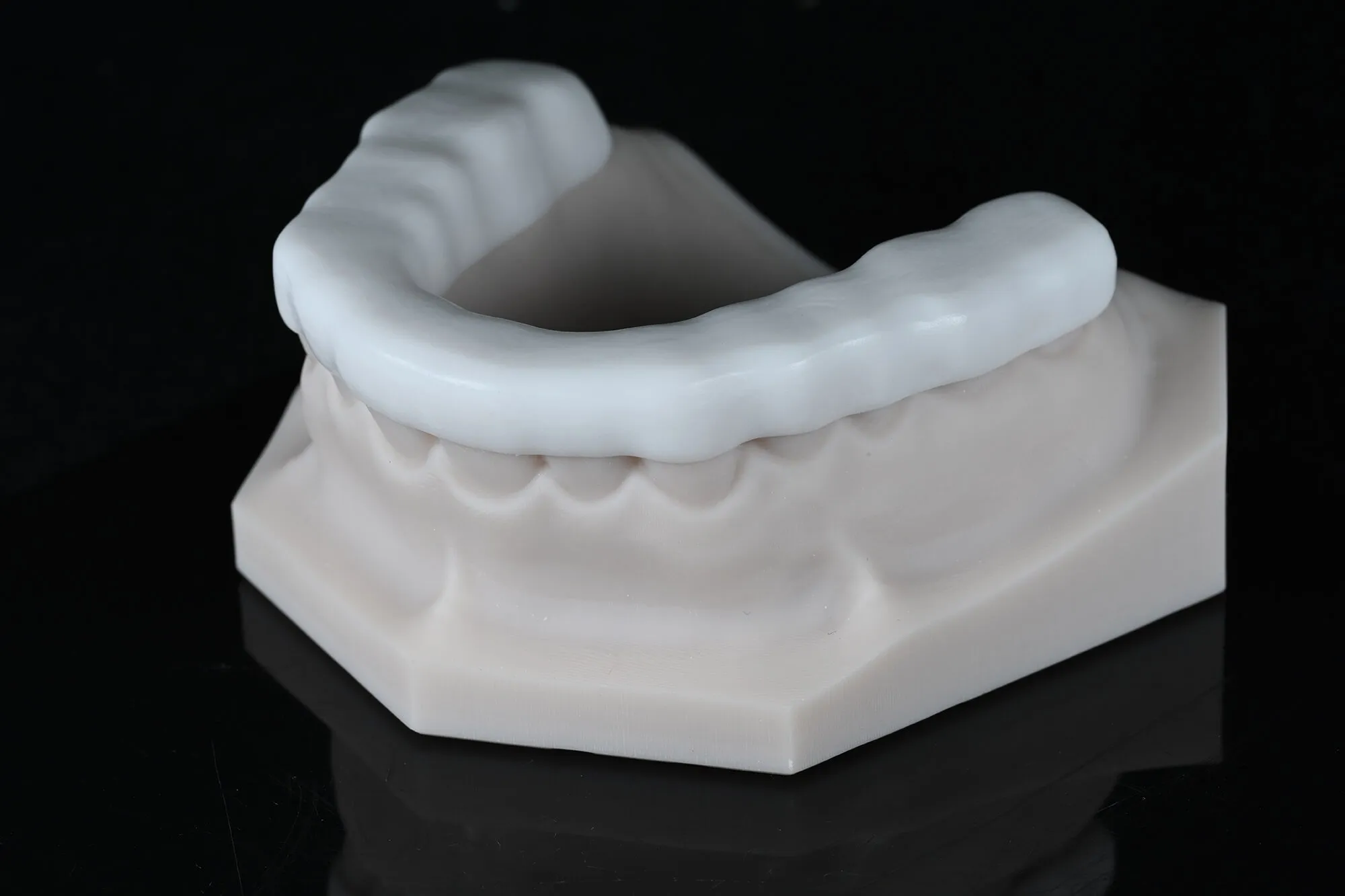
Vapour polishing gives Avant Dental’s nylon splints a smooth, refined surface that supports patient comfort, easier cleaning, and stain resistance.
Surface texture can significantly affect how a nylon splint feels, cleans, and presents at delivery. Even minor surface irregularities may become more noticeable to the patient during extended use. The final finishing stage therefore deserves close attention.
Avant Dental offers vapour-polished splints that combine the established properties of nylon with a smoother, more refined surface. The process does not change the purpose of the appliance. It simply improves the surface that patients see, touch, clean, and wear each night.
Nylon gives the splint its strength, flexibility, fracture resistance, and reduced bulk. Digital design establishes its form, retention, and occlusal scheme. Vapour polishing then modifies all surfaces after manufacture.
Dentists do not need to understand every technical setting inside the polishing chamber. However, a clear understanding of the process can help dentists to explain the appliance, assess its finish, provide suitable care instructions, and discuss adjustments with the dental laboratory.
Understanding the surface of printed nylon
Nylon has become a useful material for modern occlusal splints because it combines strength with flexibility. Avant Dental can manufacture a nylon splint to a minimum thickness of approximately 1.5 mm. A conventional hard splint generally requires at least 2 mm, while a hard-soft splint may require 3.5 mm. The reduced bulk can help patients who find a rigid or bulky appliance difficult to tolerate.
Nylon also resists cracking and fracture. Its flexibility allows the appliance to engage the teeth without creating the same rigid feel as an acrylic splint. These properties make nylon a useful option for many patients with mild to moderate bruxism, patients with sensitive teeth or gums, and patients who need protection for cosmetic restorations.
However, the manufacturing process can leave microscopic texture on the surface of a printed nylon splint. Powder-based printing builds the appliance in successive layers. This creates an accurate form, but the untreated surface can retain small pits, pores, and irregularities. These features may not compromise the digital design, but they can affect the final texture and appearance of the splint.
A nylon splint can remain strong, flexible, and accurately designed without vapour polishing. However, the polishing process aims to make that surface smoother, less porous, and more uniform.
How does vapour polishing work?
Vapour polishing is a controlled post-processing technique for 3D-printed polymers. It uses a solvent in vapour form to soften the outermost layer of the material for a limited period. The softened nylon then reflows across microscopic surface irregularities before it stabilises again.
This process does not add a coating. Rather, it modifies the existing nylon surface. As a result, it does not create a separate surface layer that can peel away. The treatment acts mainly on the exterior while the core of the appliance retains the form created through the digital design and manufacturing process.
The laboratory first prepares the printed appliance and removes residual manufacturing material. The appliance then enters a sealed processing chamber. The system controls factors such as temperature, pressure, solvent concentration, and exposure time. These settings must suit the polymer and the geometry of the splint.
Inside the chamber, solvent vapour reaches the exposed surfaces of the splint. It can travel across curves, undercuts, and recessed contours that may prove difficult to polish evenly with a rotary instrument. The vapour temporarily softens the surface, which helps the nylon redistribute across small pits and high points.
The splint must dry and stabilise after polishing. Lab technicians then inspect the result for surface consistency, detail, and overall quality. The finished splint will typically showcase a smoother and glossier appearance than untreated printed nylon.
| Stage | What happens | Surface result |
| 3D printing | The printer creates the appliance from successive layers of nylon | The printed form can retain microscopic texture and porosity |
| Preparation | Technicians remove residual manufacturing material and clean the appliance | The clean surface becomes ready for controlled finishing |
| Vapour exposure | The chamber exposes the appliance to solvent vapour under controlled conditions | The outermost nylon layer temporarily softens |
| Surface reflow | Surface tension redistributes the softened nylon | The material reduces microscopic pits and irregularities |
| Drying and inspection | Technicians stabilise and check the appliance | A smoother, more uniform surface remains |
Vapour polishing versus conventional polishing
Dental laboratories have long used mechanical methods to finish polymer appliances. A lab technician may use rotary instruments, abrasives, tumbling, or a combination of methods to remove roughness and create an acceptable surface.
Mechanical polishing remains valuable because it gives the technician direct control over a specific area. It can also support local refinements after manufacture. However, the result depends on tool access, appliance geometry, abrasive selection, and technique. A rotary instrument cannot always contact every curve and recess at the same angle.
Vapour processing takes a different approach. The vapour moves throughout the chamber and acts on exposed surfaces without requiring direct tool contact. Manufacturers describe this as a non-line-of-sight process. In practical terms, the vapour can reach complex contours that may be difficult to approach mechanically.
The controlled chamber also supports consistency across the entire splint surface. The system applies a defined processing cycle instead of relying solely on pressure and contact from a handheld tool. This does not remove the need for skilled technicians. The laboratory still needs to prepare, position, inspect, and approve every splint.
Dentists should also distinguish surface finish from fit. Digital records, design decisions, material behaviour, and manufacturing accuracy determine how the splint seats and functions. Vapour polishing refines the surface. It does not correct an inaccurate scan, an unsuitable design, or an incorrect bite registration.
| Consideration | Conventional mechanical polishing | Vapour polishing |
| Method | Tools or abrasive media remove surface material | Controlled vapour softens and reflows the outermost surface |
| Contact | The instrument must physically reach and contact the polishing area | Vapour reaches exposed curves and recessed contours |
| Control | The technician controls pressure, access, and polishing time | The processing cycle controls temperature, pressure, and exposure |
| Consistency | Technique and appliance geometry influence the result | Defined settings support a uniform finish across compatible surfaces |
| Appearance | The process creates a mechanically polished surface | The process creates a smooth, glossy, and refined surface |
What does the surface change mean for patients?
A laboratory process only becomes clinically relevant when it changes the experience of the dentist or patient. In vapour-polished nylon splints, the most relevant changes concern surface feel, cleanability, stain resistance, and appearance.
-
A smoother surface feel
The tongue can detect small variations in an appliance that may appear insignificant outside the mouth. Patients also wear an occlusal appliance close to the cheeks, gingivae, and other soft tissues for extended periods. A rough or grainy finish may therefore feel more noticeable than a dentist expects.
Vapour polishing reduces microscopic surface irregularities and produces a smoother feel. This refinement may help reduce the awareness of roughness against the tongue and oral tissues. It can support a more comfortable wearing experience, particularly for patients who are sensitive to texture.
Comfort still depends on more than polishing. Thickness, border design, retention, occlusion, and the patient’s individual tolerance all influence the result. A smooth surface cannot compensate for an overextended border or an unsuitable design. However, it removes one potential source of unwanted texture from an otherwise well-designed appliance.
-
Easier routine cleaning
Patients must clean nylon splints regularly. Saliva, plaque, food debris, and staining compounds can collect on any oral appliance during use. Surface irregularities create additional locations where this material may accumulate.
Vapour polishing reduces the pits and crevices on the printed surface. A smoother surface means fewer microscopic recesses to occupy, which may make routine cleaning more manageable.
However, vapour polishing does not make the splint antibacterial or maintenance-free. Patients must still follow the cleaning instructions from their dentist. They should also store the appliance correctly and bring it to review appointments so the dentist can assess hygiene, wear, retention, and occlusion.
-
Improved stain resistance
Coffee, tea, red wine, food pigments, and routine oral exposure can affect the appearance of a nylon splint over time. A porous or irregular surface gives fluids and pigments more opportunity to enter or remain within the surface texture.
The vapour process creates a sealed surface that can reduce the opportunity for fluid and staining compounds to penetrate microscopic pores. As a result, vapour-polished splints offer improved stain resistance compared with untreated printed nylon.
But stain resistance does not mean stain proof. Cleaning habits, diet, storage, wear, and the age of the appliance will continue to affect its appearance. The benefit lies in reducing surface susceptibility rather than preventing every form of discolouration.
-
A more refined appearance
Patients often form an immediate impression when they first receive a splint. A smooth, glossy surface looks more finished than the grainy texture associated with untreated printed nylon.
This premium appearance has a practical role. It can help the dentist demonstrate the quality of the splint and explain the manufacturing process. The patient can see and feel a clear difference in the final surface without needing to understand the chemistry behind it.
However, appearance does not replace clinical function. The appliance must still fit correctly, provide the prescribed occlusal relationship, and suit the patient’s condition. Vapour polishing complements those requirements through a more refined final presentation.
| Surface characteristic | What the patient may notice | Why it matters to the dentist |
| Reduced surface roughness | A smoother feel against the tongue and oral tissues | Surface refinement supports comfort during regular wear |
| Reduced microscopic porosity | Less material accumulating within surface irregularities | The appliance may prove easier for the patient to clean |
| Greater resistance to staining | A cleaner-looking appliance over time | The finish can help preserve the appliance’s appearance |
| Smooth, glossy finish | A more refined look and feel at delivery | The dentist can demonstrate a visible and tactile quality difference |
| Uniform surface treatment | Consistent texture across exposed contours | The appliance arrives with a controlled final finish |
Does vapour polishing change the strength or fit?
Nylon already provides the underlying strength and flexibility of the appliance. Vapour treatment modifies the surface. Its effect on mechanical properties can vary according to the polymer, printing method, part geometry, solvent, and processing settings. But a properly controlled process can refine the surface while largely preserving the material’s underlying performance.
The same applies to fit. A controlled process aims to preserve the appliance’s designed geometry, but the laboratory must match the cycle to the material and part. Excessive or unsuitable exposure could affect detail or create an uneven surface.
This is why vapour polishing requires more than placing an appliance inside a chamber. The process depends on appropriate settings, positioning, drying, and quality control.
What happens after delivery?
Patients should care for vapour-polished nylon splints in much the same way as other removable oral appliances. They should clean the splint according to the dentist’s instructions, store it in its case, and avoid methods that could damage or distort the material.
Dentists should check the appliance during follow-up appointments. Review should include the fit, occlusal contacts, wear pattern, surface condition, and patient experience. A polished finish does not remove the need for routine clinical assessment.
Chairside adjustment requires extra consideration. An adjustment mechanically removes material from the treated surface in that location. The adjusted area may therefore lose some of its original smoothness and gloss. Dentists should use an appropriate finishing protocol or contact Avant Dental for advice when an appliance requires significant adjustment or laboratory refinishing.
A refined finish within a complete digital workflow
The quality of a nylon splint depends on several connected stages. Accurate records give the laboratory a reliable starting point. The selected material provides the required strength, flexibility, and thickness. Manufacturing reproduces the approved form. Surface finishing then prepares the appliance for delivery and ongoing use.
Vapour polishing does not replace any of these stages. It completes them. The process refines the surface while preserving the advantages that make nylon useful for modern occlusal splints.
For the patient, the result is tangible. The appliance feels smoother, looks more refined, resists staining, and may prove easier to keep clean. For the dentist, the finish provides another way to support comfort and present a carefully manufactured splint.
Avant Dental is a full-service dental laboratory. To find out more about working with us, please email [email protected] or phone 1800 287 336.