

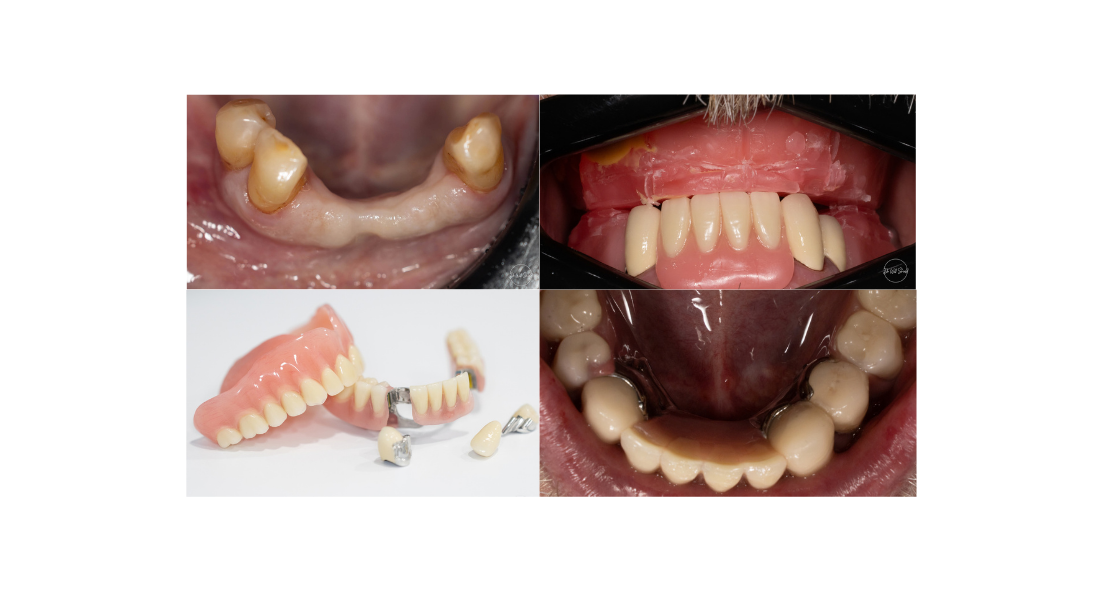
Initial Diagnosis
Dr Will Shield, a general dentist in Cairns, reviewed a 62-year-old male patient before the patient commenced bisphosphonate treatment for severe osteoporosis. The treatment plan needed to identify which teeth could be retained and complete necessary extractions before the medication commenced, to reduce the risk of medication-related osteonecrosis of the jaw (MRONJ) associated with later extractions.
Only tooth 25 remained in the upper arch. Teeth 34 to 43 remained in the lower arch, but teeth 32 to 42 had minimal bone support, caries, and a poor long-term prognosis.
Teeth 34, 33, and 43 were sound. However, their natural contours offered limited retention for a partial denture, and significant bone loss in the posterior mandible further complicated denture support and stability. The patient also wanted to avoid visible clasps.
Dr Shield needed to establish a stable, retentive lower denture design around the three teeth suitable for retention, while allowing the patient to proceed with medical treatment.
Treatment Plan
Dr Shield discussed the case with Ian Feigen, Head of Technical at Avant Dental Lab, using an initial intraoral scan before preparing the remaining teeth.
The agreed design combined a full upper denture with a lower cobalt chrome partial denture. PFM crowns on teeth 34 and 43 incorporated two key-and-keyway precision attachments with milled reciprocal arms. Tooth 33 also received a PFM crown.
This design built retention into the crowns and met the patient’s request to avoid visible clasps. Retaining the three sound teeth also provided anterior support where the resorbed posterior ridge offered little.
The clinical and laboratory workflow comprised seven visits:
- Extractions and healing
Dr Shield extracted tooth 25 and teeth 32 to 42. The plan allowed time for healing before the patient commenced bisphosphonate treatment. - Initial scan and laboratory planning
An intraoral scan provided the basis for Dr Shield’s discussion with Avant Dental. Together, they planned the crown and denture design around the available abutment teeth and the patient’s aesthetic requirements. - Tooth preparation and scan
Dr Shield prepared teeth 34, 33, and 43 for PFM crowns and scanned the preparations. He fitted Luxatemp temporary crowns. - Crown try-in and pick-up impression
Dr Shield tried in the PFM crowns and checked their fit. He then took a polyvinyl siloxane (PVS) pick-up impression with the crowns seated, so Avant Dental could fabricate the framework to their exact position. - Bite registration and framework assessment
Dr Shield recorded the bite and checked the framework fit. From this appointment, he used PMMA (polymethyl methacrylate) temporary crowns made by Avant Dental. Replacing the Luxatemp temporaries at each visit had proved time-consuming. - Denture try-in
Dr Shield completed a try-in of the full upper denture and lower cobalt chrome partial denture before final fabrication. - Crown cementation and denture insertion
At the final appointment, Dr Shield cemented all three crowns with RelyX Universal while the finished lower denture remained seated. This maintained the crown positions established for the precision attachments. Before cementation, he coated the chrome framework with glycerine to limit cement overflow and prevent excess cement from adhering to it. He tack-cured the cement, removed the excess, and took out the denture before completing the final cure. He then fitted the finished dentures and checked their fit.
For future cases with a comparable number of appointments, Dr Shield would plan to use laboratory-made PMMA temporaries from the preparation appointment where possible.
Treatment Summary
- Extracted tooth 25 and teeth 32 to 42 before bisphosphonate treatment.
- Retained teeth 34, 33, and 43 and restored them with PFM crowns.
- Incorporated key-and-keyway precision attachments with milled reciprocal arms into the crowns on teeth 34 and 43.
- Combined intraoral scans with a PVS pick-up impression to transfer the seated crown positions.
- Fitted a full upper denture and a lower cobalt chrome partial denture.
- Cemented the crowns with the lower denture seated to maintain attachment alignment.
Final Outcome 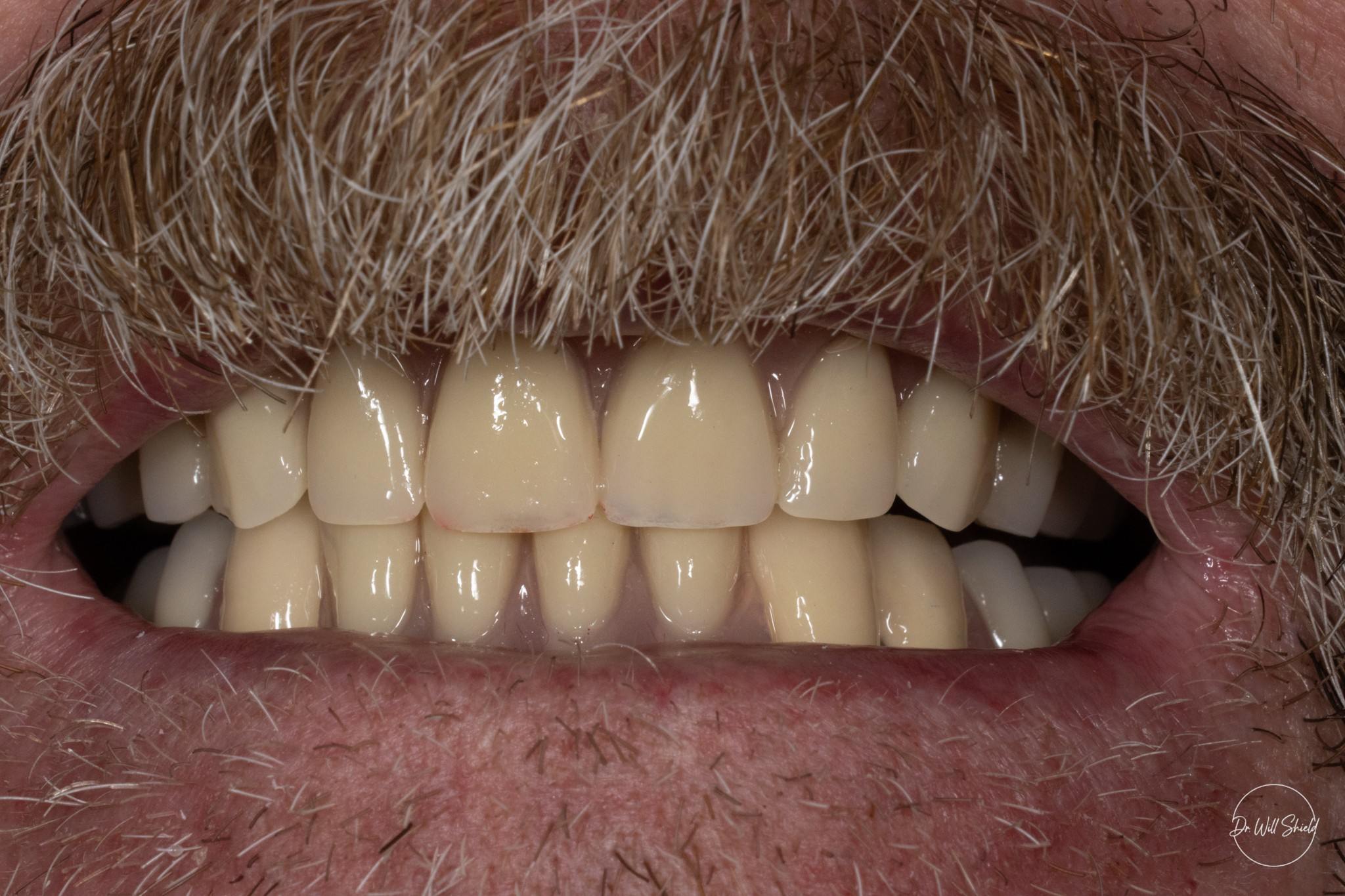
Dr Shield reported an excellent fit. The patient initially experienced some pressure, which eased, and the dentures were firm and stable.
“Working collaboratively with Will, we carefully pre-planned the workflow to address the clinical challenges presented by the limited number of abutment teeth, while also respecting the patient’s request to avoid visible clasps. These considerations led us to use precision attachments incorporated into PFM crowns, combined with a lower chrome partial denture, to achieve the required retention while maintaining an aesthetic outcome,” says Ian Feigen, Head of Technical at Avant Dental.
Dr Shield also highlighted the support he received throughout treatment.
“Ian was brilliant. He talked the case through with me at the start and helped me work out the best way forward at each step. Whenever I had a question along the way, the team at Avant Dental was there to answer it.”
See what’s possible with dentures and crowns
Discuss your next denture and crown case with Avant Dental. Visit avantdental.com.au or call us on 1800 287 336.
All case studies presented by Avant Dental are done so with permission from the ordering dentist. No patient details are shared, and all representations are true and accurate to the case. And while we may have used some AI for research purposes, this article was written by a person.